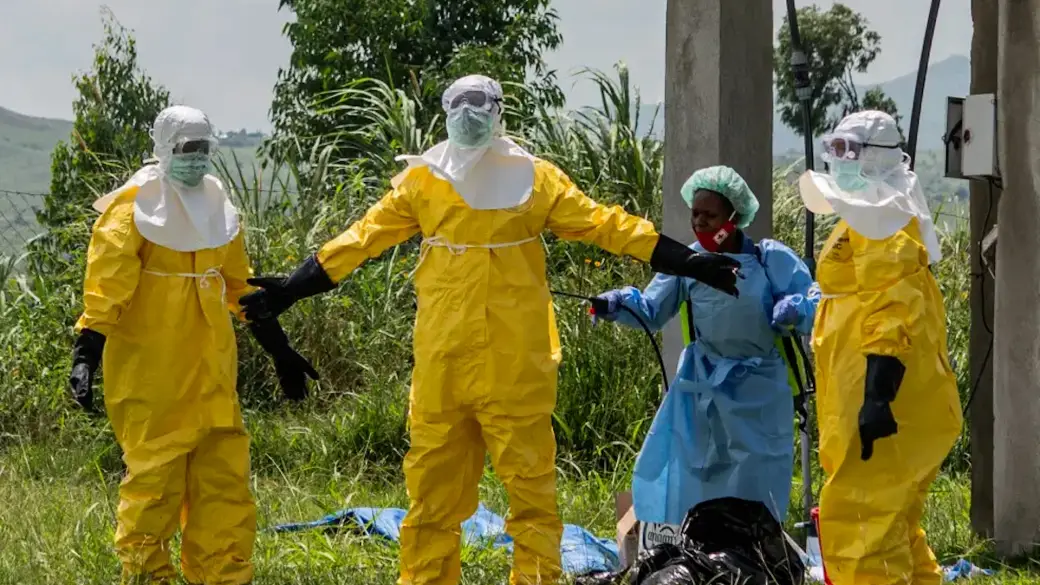
WHO Warns Ebola Outbreak in Eastern DRC Is Outpacing Response as Cases Top 900
A Bundibugyo-strain Ebola outbreak in the conflict-affected eastern provinces of the Democratic Republic of Congo has been declared a Public Health Emergency of International Concern, with over 900 suspected cases, approximately 220 suspected deaths, and confirmed spread to Uganda. WHO Director-General Tedros Adhanom Ghebreyesus has publicly warned that the outbreak is outpacing response efforts and will likely worsen, citing delayed detection, attacks on health facilities, and the complete absence of approved vaccines or treatments for this strain. At least three health facilities were attacked and burned in a single week, forcing patients — including at least one confirmed Ebola-positive individual — to flee into surrounding communities. The outbreak is unfolding against compounding structural failures: the Bundibugyo strain has no pharmaceutical countermeasures, large portions of the outbreak zone are controlled by armed rebel groups beyond the reach of containment operations, and the global health surveillance architecture has been weakened by the U.S. withdrawal from WHO and subsequent funding cuts. If the virus establishes sustained transmission in Goma — a rebel-controlled city with an international airport — the risk of broader regional spread increases qualitatively.
This is the most rapidly expanding Ebola outbreak at its early stage in recorded history, made uniquely dangerous by the convergence of three compounding failures: a strain for which no vaccines or treatments exist, a conflict environment that prevents standard containment, and a degraded global health surveillance and response architecture following the U.S. withdrawal from WHO and the subsequent 25% WHO workforce reduction. If the outbreak establishes sustained community transmission in Goma — an M23-controlled city with international airport connections — the risk of regional and global spread increases qualitatively.
The facts, with receipts.
WHO Director-General Tedros Adhanom Ghebreyesus stated on May 25, 2026 that the Ebola outbreak is outpacing response efforts and that responders are playing catch-up due to delays in detecting cases.NPR
The WHO declared the Ebola outbreak in DRC a Public Health Emergency of International Concern.NPR
The outbreak is caused by the Bundibugyo strain of Ebola, for which there are no approved vaccines or treatments.NPR
At least three attacks on health facilities occurred in Ituri province in one week, including two attacks on the same hospital in Mongbwalu.NPR
Uganda confirmed seven total Ebola cases as of May 25–26, 2026, including health workers at a private hospital in Kampala.NPR
The outbreak is centered in Ituri and North Kivu provinces in eastern DRC, regions characterized by active armed conflict and insecurity.BBC News
Ten African countries are at elevated risk of spread according to Africa CDC: Angola, Burundi, Central African Republic, Republic of Congo, Ethiopia, Kenya, Rwanda, South Sudan, Tanzania, and Zambia.South China Morning Post
The full briefing.
The most serious Ebola emergency in years is unfolding in eastern Democratic Republic of Congo, and the world's top health official has said publicly what outbreak responses rarely concede: the disease is winning. At a virtual African Union ministerial meeting on May 25, 2026, WHO Director-General Tedros Adhanom Ghebreyesus stated that the outbreak is outpacing response efforts and is likely to get worse before it gets better. The following day, he and WHO's Health Emergencies Programme chief Chikwe Ihekweazu flew to the epicenter in Bunia, a signal of institutional seriousness that also underscored how far the response has fallen behind.
The outbreak is caused by the Bundibugyo strain of Ebola — a distinct virus species identified only in 2007, with no approved vaccines and no approved treatments. This is the defining constraint of the current crisis. When the 2018–2020 Ebola outbreak in the same region killed over 2,200 people, it was eventually brought under control in part through ring vaccination — immunizing contacts and responders using an approved vaccine. That tool does not exist for Bundibugyo. Responders are managing one of the fastest-growing Ebola outbreaks on record with supportive care only, in the middle of an active armed conflict. As of May 25–26, the outbreak had recorded over 900 suspected cases and 101 confirmed cases in DRC. The death toll is contested: the WHO Director-General cited approximately 220 suspected deaths, while DRC government figures on the same day ranged from 119 to 204 — a discrepancy that has not been publicly explained and may reflect differences in how suspected versus confirmed deaths are classified, or data collection inconsistencies across provinces. Those figures should be treated as a range, not a single authoritative count.
As of May 25–26, 2026, the outbreak has recorded over 900 suspected cases, 101 confirmed cases, and approximately 220 suspected deaths in DRC, with Uganda confirming seven cases including health workers in Kampala. WHO has declared a PHEIC, approximately $500 million in international pledges have been mobilized against an estimated $519 million need, and Tedros traveled to Bunia on May 26 to demonstrate political commitment — but the WHO's own Director-General has publicly stated the outbreak will likely get worse before it gets better.
Detection itself came late, and there is evidence it came far later than the official timeline suggests. The DRC government declared the outbreak on May 15, 2026, based on a first formally identified case from April 24 — a nurse in Bunia whose subsequent burial in Mongbwalu likely spread infection further. But three Red Cross volunteers died on March 27 after handling bodies during work unrelated to Ebola response, and if those deaths are eventually confirmed as Ebola — which has not yet been established through laboratory evidence — the virus may have been circulating undetected for nearly two months before official recognition. An additional factor compounded the delay: early laboratory tests screened for the more common Zaire strain of Ebola rather than Bundibugyo, returning false negatives while transmission chains grew. Who made the decision to test for the wrong strain, and whether this was standard protocol or a protocol failure, has not been reported.
The response has been further destabilized by violence. Between May 22 and May 25, at least three separate attacks on health facilities occurred in Ituri province. An MSF isolation center in Mongbwalu was set on fire on May 23, forcing 18 Ebola patients to flee; one of them later tested positive and remains at large in the community. On May 25, the main hospital in Mongbwalu sustained four waves of attack, seven additional patients fled, and a critically ill patient with active symptoms died while attempting to escape. Congolese police and soldiers ultimately intervened. These attacks reflect documented skepticism: surveys suggest as many as one in three people in Ituri do not believe the virus is real. Residents have described Ebola as a foreign fabrication and accused health workers of exploiting the outbreak. Coverage has tended to frame this as irrational resistance; it has largely omitted the historical context — colonial medical exploitation, repeated failures of state services, and prior broken promises from international health responders — that explains why distrust is deeply rooted rather than random. Contact tracing has reached only about 20 percent of identified contacts on a given day, reflecting how far the response is from basic containment thresholds.
On social platforms, the dominant discourse amplifies the WHO's calls for more international aid and for countries to lift travel bans that are impeding responder access to DRC — a framing that received more emphasis online than in mainstream headlines, which focused on countries imposing rather than lifting restrictions. Science and global affairs influencer accounts have highlighted the Bundibugyo strain's lack of vaccines and treatments with numerical specificity. A lower-volume stream recycles post-COVID skepticism about WHO's institutional legitimacy, treating the PHEIC declaration as motivated by institutional self-interest rather than genuine epidemiological need. Public search interest peaked on May 23 and has since declined to roughly a third of that level, suggesting the outbreak captured broad attention at initial escalation but is not sustaining that intensity as the situation develops.
The outbreak is erupting against a backdrop of accumulated structural failures. Eastern DRC has experienced more Ebola outbreaks than any other region in the world, in part because extreme poverty, continuous armed conflict, and degraded health infrastructure create near-ideal conditions for transmission and containment failure. Large portions of the current outbreak zone — including confirmed case locations in Goma and Bukavu — are controlled by the M23 rebel movement, backed by Rwanda, which captured Goma in January 2025. Standard health containment operations require freedom of movement that does not exist in rebel-controlled territory. Compounding this, the United States withdrew from WHO in January 2025, eliminating approximately $1.3 billion annually from the organization's budget. WHO subsequently announced plans for a 25% workforce reduction. DRC Health Minister Roger Kamba has stated directly that U.S. aid cuts are complicating the response, and reporting indicates surveillance systems were already weakened by donor funding reductions before the outbreak began. The specific programs cut and their precise causal role in detection delay are not fully documented.
Approximately $500 million in international pledges had been secured by May 25 against an estimated need of $519 million — a figure expected to rise. The World Bank committed $160 million, the United States $82 million, and European partners approximately $57 million. Whether those pledges have been disbursed, rather than merely committed, has not been confirmed. A vaccine candidate for Bundibugyo is in development at the University of Oxford, with clinical trials potentially beginning in two to three months — but that timeline offers no protection for anyone currently exposed. The key open questions are whether access arrangements can be reached in M23-controlled territory, whether the pace of contact tracing can be raised above its current 20 percent daily follow-up rate, and whether health facility security can be established in Ituri well enough for treatment to resume at scale.
The numbers that matter.
The same facts.
Different stories.
Institutional Failure / Response Overwhelmed
High reachWHO Director-General's 'outpacing us' statement; attacks on and burning of MSF isolation tents; escaped Ebola-positive patient circulating in community; absence of approved Bundibugyo vaccines; 20% contact tracing follow-up rate; delayed detection due to wrong-strain testing.
What response measures are being implemented and at what scale; contact tracing successes; whether any transmission chains have been interrupted; patient recovery rates; historical context for why community distrust exists.
Resource Mobilization / Solvable with Funding
Medium reach$500 million in international pledges as of May 25; World Bank $160 million contribution; U.S. $82 million; European contributions; vaccine development under way at Oxford; national preparedness systems activating in India, Italy.
Whether pledges have been disbursed; what response efforts actually consist of operationally; community resistance as a barrier that funding alone cannot solve; the conflict environment preventing access to outbreak zones.
Community Resistance as Primary Obstacle
High reachThree health facility attacks in one week; 18 patients fleeing burned isolation tents; one confirmed Ebola-positive patient at large in community; ActionAid survey suggesting one in three Ituri residents don't believe virus is real; resident characterizations of Ebola as fabricated; demands for traditional burial of Ebola victims.
Historical reasons for community distrust (colonial exploitation, prior broken promises, aid workers arriving alongside military forces); structural causes of skepticism; voices from communities in their own words explaining their perspective; whether trust-building measures have been attempted and what they consisted of.
Managed National Vigilance / Controlled Risk
Low reachItalian health officials stating risk 'remains very low'; Indian health minister reviewing preparedness systems; enumeration of national surveillance mechanisms (NCDC, ICMR, IDSP); Italy's hospitalized aid workers likely exposed to malaria rather than Ebola; WHO's own statement that global spread risk is low.
Severity of the outbreak in Africa; whether European preparedness is evidence-based or aspirational; vulnerability of airports and border crossings in European countries; cost of response measures on border communities.
What the signal looked like.
Official Response Urgency
WHO chief Tedros is in DRC's Ituri/Bunia calling for more international aid and urging travel ban removal to enable responder access; outbreak is complex due to conflict but can be stopped.
Vaccine and Treatment Gap Crisis
This is DRC's 17th Ebola outbreak with the rare Bundibugyo strain; no approved vaccine or treatment is available; response teams are fighting an outbreak that has already recorded more cases than any prior outbreak at the same point in its timeline.
WHO Credibility and Corruption
WHO lost all credibility post-COVID as a corrupt vehicle for pharmaceutical profit; pandemic claims are exaggerated or fabricated for institutional benefit.
'Ebola' peaked at maximum relative search volume (100) on May 23, 2026, and has declined to approximately 30–45% of peak by May 30, indicating sustained but decelerating public interest. 'W.H.O.' showed near-zero relative search volume throughout the window with a single isolated spike to 100 on May 25, suggesting the institutional angle is not driving organic search behavior. No related queries data was returned by the trends service.
No Polymarket markets directly related to the DRC Ebola outbreak or WHO response were identified in the query window. The five markets returned were unrelated to this Story (PLL sports, MLB, XRP, Manchester City FC, South Korea GDP).
The thread, in order.
First identified Bundibugyo ebolavirus outbreak in Bundibugyo district, Uganda, resulting in 149 cases and 37 deaths — the founding epidemiological event for characterizing this specific strain.
Established institutional memory for Bundibugyo strain; Uganda therefore has direct prior experience with this exact pathogen. Also the only prior Bundibugyo outbreak with similar scale that can inform case fatality rate expectations.
Second Bundibugyo ebolavirus outbreak in DRC, resulting in 57 cases.
The only prior Bundibugyo outbreak in DRC; very small scale compared to current crisis.
Start of 2018–2020 DRC Ebola outbreak in North Kivu and Ituri provinces — the second-largest Ebola outbreak ever recorded, ultimately killing over 2,200 people. Involved the Zaire strain, for which a vaccine (rVSV-ZEBOV) was deployed.
Defining precedent for the current outbreak in the same geography. Established both response templates (ring vaccination, community engagement) and community resistance patterns (attacks on facilities, distrust of responders). Also the outbreak that tested and revealed limits of the post-2014 WHO reforms.
End of 2018–2020 DRC Ebola outbreak.
Demonstrated that containment is possible even in conflict-affected eastern DRC, but required ring vaccination — a tool that does not exist for Bundibugyo strain.
United States withdrew from WHO under President Trump's executive order, eliminating approximately $1.3 billion annually from WHO's budget — the largest single funding cut in WHO history.
Directly degraded WHO's surveillance and response capacity prior to the current outbreak. DRC Health Minister Kamba has attributed response difficulties to U.S. aid cuts.
Chikwe Ihekweazu appointed Acting Regional Director of the WHO African Region in addition to his existing role as WHO Health Emergencies Programme Executive Director.
Indicates WHO was managing exceptional institutional load even before the Ebola outbreak. Ihekweazu simultaneously manages global health emergencies and the Africa region during this crisis.
DRC Health Minister Kamba declared end to mpox national emergency as transmission dropped from ~2,400 cases/week at start of 2025 to approximately 170 cases.
DRC's health ministry was transitioning out of active mpox emergency response into Ebola emergency response within weeks — suggesting continuous outbreak-management burden with limited institutional recovery time.
Tedros announced WHO required 25% staff cost reductions — significant organizational restructuring occurring simultaneously with the DRC Ebola emergency response.
WHO's operational capacity for the Ebola response is constrained by simultaneous institutional contraction. By mid-2026, WHO expected to shed approximately 25% of its workforce.
Three Red Cross volunteers died after handling bodies during work unrelated to Ebola response in Mongbwalu area. International Federation of Red Cross and Red Crescent Societies believes they contracted Ebola during these activities.
If confirmed as Ebola deaths, this would push the true outbreak origin back approximately one month before the April 24 first diagnosed case, indicating the virus circulated undetected for significantly longer than official records suggest.
First formally identified case: a nurse presented Ebola symptoms in Bunia, Ituri province, according to internal Congolese health ministry report. She was later buried in Mongbwalu.
Official outbreak origin per Congolese health ministry records. A spate of unexplained deaths in Mongbwalu throughout April, including four health workers in a single week, preceded diagnosis. Early testing screened for Zaire strain, returning false negatives.
A 59-year-old Congolese man was admitted to a Kampala, Uganda hospital and died three days later before being diagnosed with Ebola — Uganda's first case.
The initial cross-border transmission event that brought Ebola to Uganda's capital. Kampala's status as a major regional transport hub made this epidemiologically significant.
DRC government officially declared the Ebola outbreak.
Official outbreak declaration date — occurring weeks after the first probable cases and after community transmission had already spread significantly.
WHO declared the DRC Ebola outbreak a Public Health Emergency of International Concern (PHEIC).
The highest international health alarm level, triggering international response mobilization. Declared at over 300 suspected cases and 88 deaths in DRC plus two deaths in Uganda.
WHO raised its risk level for the DRC Ebola outbreak at the national level to 'very high.' A treatment center in Rwampara, Ituri province was burned by residents after family members were denied access to a body for burial.
First of three health facility attacks in one week; also the date WHO formally escalated its national risk assessment.
Uganda announced its first local infections — a driver and health worker connected to the initial Congolese patient. Africa CDC identified ten countries at elevated risk. MSF isolation tents in Mongbwalu were set on fire; 18 Ebola patients fled.
Multiple simultaneous escalation events: first evidence of local Ugandan transmission, regional risk mapping, and second health facility attack with confirmed escaped positive case.
At virtual African Union ministerial meeting, Tedros stated the outbreak is 'outpacing us' and 'likely to get worse before it gets better.' Mongbwalu hospital sustained four waves of attacks; seven more patients fled; one critically ill patient died while fleeing. International funding pledges reached approximately $500 million.
The central event of this Story: the WHO Director-General's public acknowledgment that the response is failing, occurring simultaneously with the most severe health facility attacks and near-sufficiency of international funding pledges.
Tedros and Chikwe Ihekweazu traveled to DRC. Uganda's case count stood at seven confirmed cases including health workers at a private Kampala hospital.
WHO's most senior leadership personally deployed to the outbreak epicenter — an indicator of institutional seriousness and political commitment.
DRC Health Minister Kamba traveled to Bunia in Ituri province alongside the Communications Minister to oversee government response.
Senior DRC government officials deployed to the epicenter — the first direct government presence at the outbreak center at ministerial level.
The relationships driving it.
Cooperative under significant strain. Kamba's public attribution of response difficulties to U.S. aid cuts is directed at the international community rather than WHO specifically, and both parties are aligned on resource needs. However, WHO's reduced capacity due to funding cuts limits what it can deliver as a partner.
Operationally cooperative but tense. MSF's public statement about airspace closures preventing access is unusual — typically MSF manages such problems without public disclosure — suggesting serious operational constraint. The burning of MSF's isolation tents represents an attack on the most critical treatment infrastructure in the outbreak zone.
Active armed conflict with direct consequences for outbreak containment. DRC government has no operational authority in M23-controlled Goma and Bukavu — both confirmed case locations. Health Minister Kamba's call for 'total control' of DRC territory is an implicit demand that international actors pressure M23 and Rwanda.
Strained. Health Minister Kamba has publicly attributed response difficulties to U.S. aid cuts. The U.S. has committed $82 million to the response and $23 million through the State Department, and strengthened airport screening, but is not operating through WHO channels. The U.S. travel ban on DRC, Uganda, and South Sudan nationals represents an additional friction point.
Actively cooperative on the current response, with potential for institutional competition longer-term. Both are coordinating regional response; Kaseya announced the $500 million funding pledges. Africa CDC's health sovereignty agenda could eventually position it as an alternative coordination center to WHO for African outbreaks.
Cooperative on health response while managing economic disruption from border closures. Uganda's suspension of cross-border transportation imposes economic costs on both countries. Uganda is implementing aggressive containment measures consistent with its institutional history.
Active hostility. Rwanda has simultaneously implemented entry bans on those traveling from DRC (a public health measure) while supporting the armed group that controls territory where the outbreak is occurring. The contradiction between Rwanda's public health cooperation and its conflict support is not addressed in available sources.
What no one is covering.
What response efforts actually consist of operationally — despite extensive coverage of the response 'outpacing' the outbreak, almost no reporting details what contact tracing looks like on the ground, what isolation protocols are being used, how many responders are deployed, or what treatment is provided to patients in the absence of approved drugs.
Why communities distrust health authorities — historical and structural context for community resistance is almost entirely absent; coverage characterizes resistance as irrational without exploring colonial exploitation, prior broken promises, or the historical pattern of aid workers arriving alongside military forces.
Survival rates, case fatality rates, and patient outcomes — no reporting provides the Bundibugyo strain's historical case fatality rate, current outbreak mortality rate, or any patient recovery stories; the outbreak is framed as uniformly deadly without quantitative survival context.
The diagnostic testing delay — multiple outlets note early tests were done for the wrong Ebola strain, but none explain who made that decision, whether it was standard protocol or a protocol failure, or what the technical differences are between strain-specific tests.
What 'no approved vaccine or treatment' actually means for patient care — no reporting explains what supportive care is being provided, how survival rates differ between those receiving care and those not, or distinguishes between 'no approved treatment' and 'no medical intervention.'
What we don't know.
Intelligence means marking the edges of what's verified. Here's what this story can't yet answer.
Whether the March 27 Red Cross volunteer deaths have been laboratory confirmed as Ebola. All sources hedge with 'apparently,' 'likely,' or 'believes' — no source explicitly states laboratory confirmation. If confirmed, the true outbreak origin predates the April 24 first diagnosed case by approximately one month, fundamentally altering the timeline and the severity assessment of the detection failure.
Early testing was conducted for the Zaire strain rather than the Bundibugyo strain, causing diagnostic delay — but only two Tier 2 sources report this, and no source explains who made the decision to test for Zaire, whether this was standard protocol or a failure, or how many weeks of transmission were missed as a result.
The precise operational impact of WHO's planned 25% workforce reduction on DRC field capacity — specifically whether WHO's in-country team in DRC has been reduced — is not documented in any available source. This directly affects the reliability of assessments of WHO's response capacity.
Whether the DRC government or international organizations (WHO, MSF) have made or are pursuing formal access arrangements with M23 rebel governance for health operations in Goma and Bukavu is not reported. Without knowing this, it is impossible to assess whether the M23 jurisdictional gap is being addressed.
Case fatality rate for the Bundibugyo strain in this outbreak and comparison to historical Bundibugyo outbreaks (2007–2008 Uganda: 37 deaths/149 cases; 2012 DRC: 57 cases) has not been reported, making it impossible to assess whether this outbreak is unusually virulent or behaving within historical parameters for the strain.
Specific programs defunded by U.S. and other donor aid cuts, and the causal linkage between those cuts and the detection delay in this outbreak, are not documented. NPR reports surveillance was weakened by aid cuts (single-source) and Minister Kamba attributes response difficulty to U.S. cuts, but the specific mechanisms are undocumented.
Death toll discrepancy: DRC Ministry of Communication reported 119 suspected deaths on May 24 while regional DRC figures on the same day total approximately 220 — an unexplained 85-death discrepancy that no source has explained. Could reflect classification differences, reporting lag, or data collection failures across provinces.
Whether Uganda has maintained any border crossing functionality for essential goods and health workers, or whether closures are complete, is not clearly reported — creating uncertainty about the humanitarian impact of Uganda's containment measures.
Whether the two Italian aid workers hospitalized in Milan on May 25 under Ebola protocol tested positive or negative for Ebola is not resolved in available sources — their cases could also be malaria.
Who's telling you this.
Left of center.
Mean lean −0.6 across the 43 outlets synthesized.
Scores based on editorial-positioning data. Not an endorsement or criticism.
Glossary.
- Public Health Emergency of International Concern
- The highest level of international health alarm that the WHO can declare, used when a disease event poses a risk to multiple countries and requires a coordinated international response. Abbreviated as PHEIC.
- Bundibugyo strain
- A distinct species of Ebola virus first identified in Uganda in 2007, separate from the more studied Zaire strain. No approved vaccines or treatments exist for Bundibugyo, unlike the Zaire strain.
- ring vaccination
- A disease control strategy in which everyone who may have been exposed to an infected person — their contacts and contacts' contacts — is vaccinated to create a protective 'ring' around each case, preventing further spread.
- contact tracing
- The process of identifying and monitoring all people who may have come into contact with an infected person, to catch new cases early and prevent further transmission.
- M23 rebels
- An armed rebel movement operating in eastern DRC, widely documented as receiving support from Rwanda. M23 controls Goma and Bukavu — cities in the current Ebola outbreak zone — and does not recognize DRC government authority in those areas.
- case fatality rate
- The proportion of people diagnosed with a disease who die from it, expressed as a percentage. A higher case fatality rate indicates a more lethal outbreak.