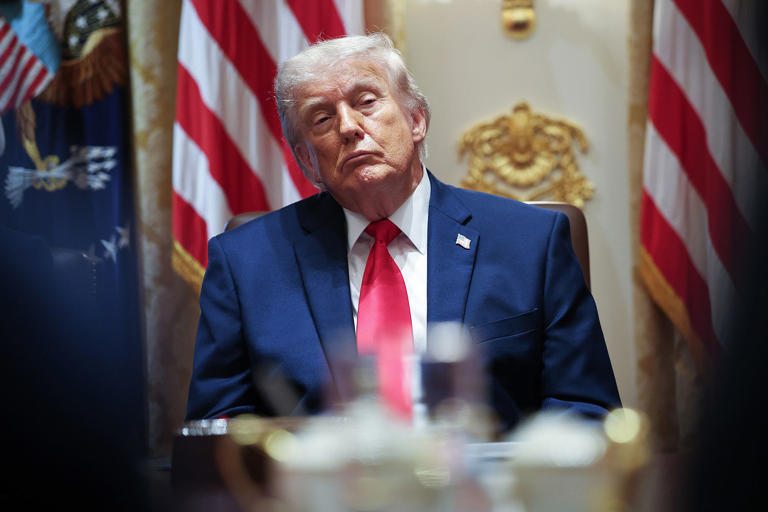
Trump Retreats on $1.8 Billion 'Anti-Weaponization' Fund After GOP Revolt and Dual Judicial Blocks
The Trump administration is stepping back from a controversial $1.8 billion fund designed to compensate alleged victims of government targeting, after Senate Republicans mounted unusually forceful internal opposition and two federal judges imposed legal constraints within days of each other. The fund was created through a Justice Department settlement of President Trump's personal lawsuit against the IRS over leaked tax returns — an arrangement critics called self-dealing because Trump's own Justice Department negotiated the deal on his behalf. Whether the retreat is permanent remains genuinely unclear: administration officials told Axios the fund is 'dead for now,' but the Justice Department's official statement says only that it will comply with the court order, and Trump has not publicly committed to scrapping the initiative. The core stakes extend beyond the fund itself — the episode has exposed limits to presidential loyalty within Trump's own party, and two judicial deadlines converging on June 12 will determine whether the fund's legal foundation can survive scrutiny at all.
This Story represents the sharpest public assertion of institutional independence by Senate Republicans during Trump's second term, revealing the limits of presidential loyalty when executive self-dealing becomes visible and electorally toxic. The dual judicial interventions—one blocking the fund's operation, one investigating the settlement that created it—demonstrate that federal courts retain meaningful constraint power over executive action even in an administration that has aggressively centralized executive authority. The structural conflict of interest at the Story's core—the president's Justice Department settling the president's personal lawsuit by creating a fund the president controls—marks a boundary case for executive power that is being tested in real time.
The facts, with receipts.
The Trump administration's Justice Department created a fund valued at approximately $1.8 billion, described as an 'anti-weaponization' fund to compensate alleged victims of government targeting.Axios
U.S. District Judge Leonie M. Brinkema of the Eastern District of Virginia issued a temporary restraining order halting the fund's creation and operation.Axios
The Justice Department stated on June 1, 2026 that it would abide by the court's ruling, while publicly disagreeing with the decision.BBC News
The fund originated from a settlement between the Trump administration and the IRS related to the 2022 leak of Trump's personal tax returns.Axios
Senate Majority Leader John Thune publicly called for the administration to shut the fund down and linked the issue to a stalled $72 billion immigration enforcement package.BBC News
Senate Minority Leader Chuck Schumer labeled the fund a 'slush fund' and announced plans to push legislation to ban it permanently.BBC News
The full briefing.
The Trump administration is retreating from an $1.8 billion fund its own Justice Department created, after a convergence of Republican Senate opposition and twin federal court rulings reduced the administration's political and legal room to maneuver. The fund, branded as an 'anti-weaponization' initiative, was paused on June 1, 2026, when the Justice Department issued a statement saying it would comply — while disagreeing — with a court order blocking the fund's formation. Administration officials separately told Axios the fund was 'dead for now,' though Trump himself has not publicly committed to abandoning it.
The fund's origins lie in a lawsuit Trump brought against the Internal Revenue Service over the 2022 leak of his personal tax returns by a contractor named Charles Littlejohn. Trump had sought $10 billion in damages. The eventual settlement, announced in mid-May 2026, dropped that claim in exchange for creating the $1.8 billion fund and — according to a single credible source — granting Trump lifetime immunity from IRS audits. The Justice Department, controlled by Acting Attorney General Todd Blanche — Trump's former personal criminal defense attorney — framed the fund as open to any American who believed they had been targeted by the government, regardless of political affiliation. A five-member board appointed by Blanche would manage payments, with recipient identities kept secret.
As of June 2, 2026, the administration has signaled retreat but Trump has not publicly committed to permanently terminating the fund—administration officials told Axios 'it's dead for now' while the Justice Department's official statement says only that it will comply with the court order pending a June 12 hearing. Two federal judges have imposed legal constraints scheduled to converge on June 12, and Senate Republicans have linked the fund's fate to passage of a $72 billion immigration enforcement package the administration needs.
The structure drew immediate fire from both parties. Republican Senator Don Bacon summarized the conflict plainly: the executive branch was, in effect, negotiating a large financial settlement with itself on behalf of the president. The most politically combustible question was eligibility: Blanche declined to rule out participants in the January 6, 2021 Capitol riot as potential recipients, saying only that Trump and his family were not eligible to apply. For senators who had previously backed pardons for January 6 defendants, a named, funded, $1.8 billion compensation mechanism was a different and harder-to-defend proposition. Senate Majority Leader John Thune publicly called for the fund to be shut down, and approximately half the Republican conference was reported to be ready to vote alongside Democrats to block it — an unusual degree of intra-party resistance. Thune linked the fund's fate directly to a $72 billion budget package for immigration enforcement agencies that the administration had made a legislative priority. Former Vice President Mike Pence called the fund 'a bad idea from the start.'
On May 29, two federal judges acted within hours of each other. Judge Brinkema in Virginia issued a temporary restraining order barring the Justice Department from taking any steps to operate the fund, and scheduled a preliminary hearing for June 12. Simultaneously, U.S. District Judge Kathleen Williams in Florida — who had presided over Trump's original IRS lawsuit — reopened that case, directing Trump's attorneys to respond by June 12 to allegations that the settlement underpinning the fund was 'premised on deception' and that the court may have been 'the victim of a fraud.' Williams's action is potentially the more consequential of the two: if the settlement that created the fund is found to be fraudulent, the fund loses its legal basis to exist. It is not yet established whether Judge Williams has authority to void the settlement entirely, or only to investigate and potentially impose sanctions — that is a significant open legal question that will bear on how serious the threat to the fund's foundation actually is.
The public response tracked closely with partisan lines, though with notable asymmetries. Mainstream media and institutional journalism accounts drove the dominant frame — a rare and revealing moment of Republican self-assertion against the president — and this framing achieved broad social media reach because it fit an established appetite for evidence of limits on Trump's party control. Conservative media largely avoided substantive defense of the fund, instead treating it as a political liability or framing the retreat as clearing obstacles for Republican legislative priorities. The administration's own stated rationale — that the fund was genuinely open to any victim of government overreach regardless of political affiliation — generated almost no organic social traction, even within conservative spaces. Whether the fund represented a legitimate attempt to address real cases of prosecutorial overreach, or was primarily a vehicle for political patronage, was a question that never received serious public examination: the debate collapsed almost immediately into partisan position-taking.
The fund's creation reflects a broader dynamic that has defined Trump's second term: the use of federal legal mechanisms to serve the president's personal and political interests, and the uneven but real resistance that emerges when that use becomes visible and electorally costly. The settlement structure at this story's core — Trump's Justice Department resolving Trump's personal lawsuit in a way that created a fund Trump's appointees control — concentrated multiple conflict-of-interest concerns in a single arrangement. DOJ's own ethics apparatus had previously identified conflict-of-interest concerns around Blanche handling Trump-related matters; whether Blanche's recusal obligations were honored with respect to the IRS settlement has not been established publicly, and is a material open question.
Two judicial hearings scheduled for June 12 will determine the next phase. Judge Brinkema's preliminary hearing will address whether to extend the block on the fund's formation. Simultaneously, Trump's attorneys face a deadline to respond to Judge Williams's fraud allegations in the Florida case. The administration has given no public indication of whether it intends to contest both proceedings or consent to any relief. Senator Schumer has stated that the administration's verbal retreat is insufficient and that only a statutory ban would be durable. Trump told reporters that the situation is one of being 'subject to the courts' — language that frames the pause as externally imposed rather than chosen, and leaves the door open to reviving the fund if the judicial and political constraints lift.
The numbers that matter.
The same facts.
Different stories.
Executive Self-Dealing and Corruption
High reachLifetime IRS audit immunity for Trump in the settlement; secret recipient identities; five-member board appointed by Blanche (Trump's former personal attorney); fund bypasses congressional appropriation; settlement negotiated between Trump's legal team and Trump's DOJ; potential January 6 rioter eligibility.
Any substantive discussion of whether genuine cases of prosecutorial overreach occurred under Biden; administration's stated rationale for the fund; DOJ's framing of the fund as open to victims regardless of political affiliation.
Rare Bipartisan Revolt Against Executive Overreach
High reachSenate Majority Leader Thune's public call to shut down the fund; Cruz's description of the Senate briefing as 'one of the roughest meetings'; approximately half the Republican conference ready to vote with Democrats; fund linked to stalled immigration enforcement package; former VP Pence calling it 'a bad idea from the start.'
Details of the settlement's legal structure and whether it was procedurally proper; substantive arguments about the fund's stated purpose; judicial reasoning for blocking the fund beyond bare procedural facts.
Judicial Accountability and Rule of Law
Medium reachJudge Brinkema's TRO and June 12 preliminary hearing; Judge Williams's reopening of the IRS case and fraud investigation; DOJ statement that it will 'abide by the Court's ruling'; convergence of judicial deadlines; procedural legitimacy of courts reviewing executive settlements.
The political pressures that also constrained the fund; Republican backlash as a co-equal constraint; substantive arguments about the fund's merits or problems beyond legal procedure.
Weaponization Victims Denied Justice
Low reachDOJ statement that fund was 'open to anybody who was so weaponized, targeted, or persecuted'; Trump's characterization of victims going to jail, families ruined, people committing suicide; January 6 defendants as victims of political prosecution; perceived Biden-era targeting of conservatives.
The conflict of interest in Trump's DOJ settling Trump's lawsuit; lack of oversight mechanisms; secret recipient identities; lifetime IRS audit immunity for Trump; Republican concern about compensating rioters who assaulted police.
What the signal looked like.
Rare GOP Backlash Forces Retreat
Trump administration is backing off the fund due to unusual Republican opposition in Congress over lack of oversight and potential payouts to January 6 defendants.
Court Order and Legal Compliance
DOJ is pausing or scrapping the $1.8B fund to comply with federal court rulings blocking it, while disputing the decisions.
Fund Intended for Weaponization Victims Including J6 Defendants
The fund was created to aid Trump supporters and January 6 defendants victimized by weaponized justice system, now killed by backlash.
Trump Administration Scraps Controversial Initiative
Trump is reconsidering or dropping the fund amid bipartisan concerns and legal setbacks.
Google Trends shows 'Trump' search interest peaked May 29 at 100 (normalized), declining to 73 by June 1 and 48 by June 2 mid-day. 'GOP' search interest peaked May 27 at 100, declining to 56 by June 1. No specific search spike for 'anti-weaponization fund' or related terms—the Trump peak corresponds to multiple simultaneous stories including Iran developments and the Kennedy Center controversy. The fund story did not generate independent search momentum beyond general Trump news interest.
Polymarket shows no relevant prediction markets for this story. General Trump approval/disapproval markets showed no significant movement June 1-2.
The thread, in order.
Charles Littlejohn, IRS contractor, leaks Donald Trump's personal tax returns to journalists.
This is the originating event for the entire chain; without the leak, there is no lawsuit, no settlement, and no fund.
Pro-Trump mob storms the U.S. Capitol during the certification of the 2020 Electoral College results, resulting in injuries to police officers, deaths, and hundreds of criminal prosecutions.
This event is the precondition for Republican senators' most visceral objection to the fund—that convicted rioters, including those who assaulted officers, could be compensated.
Pence certifies the 2020 election results despite Trump's pressure campaign and despite the riot in which crowd members chanted for his death.
This permanently alters the Trump-Pence relationship and establishes Pence as a specific kind of Republican anti-Trump voice.
Trump hires Todd Blanche to defend him in the Manhattan hush-money case and later in federal classified documents and election obstruction cases.
Establishes Blanche's role as Trump's personal criminal defense attorney—the relationship that creates the fundamental conflict of interest in this Story.
Todd Blanche confirmed as Deputy Attorney General at the start of Trump's second term.
Begins Blanche's transition from private defense attorney to government official within the Trump administration.
The Justice Department's top ethics lawyer informs Blanche that recusal from legal cases involving President Trump in his personal capacity is necessary.
Establishes that DOJ's own ethics apparatus identified the conflict of interest in Blanche handling Trump-related matters—yet the IRS settlement proceeded anyway.
The 2025 federal government shutdown—the longest in U.S. history at 42 full days—occurs under Senate Majority Leader Thune's leadership, ending when President Trump signs a continuing resolution.
Demonstrates Thune's experience managing extended legislative-executive standoffs and his willingness to sustain pressure campaigns against the administration when necessary.
Trump dismisses Attorney General Pam Bondi; Todd Blanche becomes Acting Attorney General.
Completes Blanche's ascension to the nation's top law enforcement position, consolidating Trump's control over DOJ through his former personal attorney.
Trump administration's Justice Department announces the $1.8 billion 'anti-weaponization' fund as part of the IRS settlement.
The fund's creation triggers the political and judicial opposition that defines this Story.
U.S. District Judge Leonie M. Brinkema issues temporary restraining order halting the fund's formation; U.S. District Judge Kathleen Williams reopens Trump's IRS case in Florida.
Dual judicial interventions create legal constraints that combine with political pressure to force the administration's retreat.
Mike Pence appears on Meet the Press criticizing Trump's second term, saying the 'populist right' is pushing Trump away from the conservative agenda.
Establishes Pence's public positioning as a principled conservative critic in the same period he criticized the fund.
DOJ issues statement saying it will comply with the court order; Axios reports administration officials say the fund is 'dead for now'; Speaker Johnson meets with Trump at the White House to discuss the fund.
Marks the public moment of administration retreat, though the permanence of that retreat remains contested.
Mike Pence publishes book 'What Conservatives Believe: Rediscovering the Conservative Conscience.'
Book publication coincides with Pence's criticism of the fund, suggesting a coordinated public positioning as an alternative Republican voice.
Judge Brinkema's preliminary hearing on extending the fund block; deadline for Trump's attorneys to respond to Judge Williams's fraud allegations in the Florida IRS case.
Convergence of two judicial deadlines creates compressed timeline that will clarify whether the fund's fate is permanent or tactical pause.
The relationships driving it.
In this Story, Thune's willingness to publicly call for the fund's termination and use legislative leverage against it represents the sharpest public assertion of Senate Republican independence from Trump in the second term. Thune knows Trump can target him and has survived it before; his willingness to publicly oppose reflects genuine independent judgment.
In this Story, Johnson acted as an interlocutor rather than an independent opponent, meeting with Trump on June 1 to convey concerns while not publicly leading opposition. His role reflects his dependence on Trump rather than independent power.
In this Story, Pence's criticism of the fund from a specifically constitutional-conservative standpoint represents a continuation of the principled public distance he has maintained since January 2021. His opposition to a fund that might benefit January 6 rioters is consistent with his January 6 conduct.
In this Story, Blanche acted as the executor of Trump's agenda (announcing and defending the fund) and the face of an initiative that proved politically catastrophic, raising questions about whether his personal loyalty to Trump has made him an ineffective political operator within the broader Republican coalition.
In this Story, Schumer's role is to make the political cost of maintaining the fund concrete by threatening credible legislative action with bipartisan support—a threat made possible by the Republican revolt Thune leads.
Schumer's threat to push legislation banning the fund creates pressure that Thune can relay to the administration; paradoxically, Schumer's threat may be useful to Thune as leverage in his own negotiations with Trump.
In this Story, her TRO represents the judicial constraint track that operates parallel to the political revolt and cannot be resolved by political negotiation alone.
In this Story, her action is potentially the most legally consequential because it targets the settlement itself—if the settlement is unwound, the fund has no legal basis to exist.
The briefing appears to have intensified rather than resolved Republican opposition, suggesting Blanche was unable to provide reassurances about oversight or eligibility criteria that would have satisfied Republican concerns.
What no one is covering.
What specific acts constitute 'weaponization' under this fund's criteria—no outlet provided concrete examples beyond January 6 cases.
The legal reasoning behind Judge Brinkema's temporary block—what preliminary showing the plaintiffs made, what legal theory supports blocking the fund.
Details of the IRS settlement and how it generated $1.8 billion—mechanics of how settling a $10 billion lawsuit produces a separate $1.8 billion fund.
The identities and roles of the two plaintiffs who sued to block the fund in Virginia—who they are, what retribution they allegedly suffered, why they believe they'd be excluded.
The Florida judge's specific fraud allegations and evidentiary basis—what evidence or procedural irregularities prompted Judge Williams's concern.
What we don't know.
Intelligence means marking the edges of what's verified. Here's what this story can't yet answer.
The exact legal obligations, if any, that bind the administration to maintaining the fund under the settlement terms are unclear.
Whether Judge Williams has authority to void the settlement entirely, or only to investigate and potentially impose sanctions.
The specific legal theory on which Judge Brinkema issued the TRO—Administrative Procedure Act, constitutional, or other grounds.
Whether Blanche's DOJ recusal obligations were honored with respect to the IRS settlement.
Trump's private position on the fund—whether he has internally committed to abandoning it or views the retreat as tactical.
The precise content of Blanche's Senate briefing—what he said that produced the catastrophic reception Ted Cruz described.
Whether Thune's linkage of the fund to the immigration package was a firm quid pro quo or softer priority signaling.
Who's telling you this.
Left of center.
Mean lean −0.6 across the 38 outlets synthesized.
Scores based on editorial-positioning data. Not an endorsement or criticism.
The story, visualized.
Glossary.
- temporary restraining order
- A short-term court order that immediately halts a specific action while a judge considers whether to impose a longer-term block. It requires a party to demonstrate a reasonable likelihood of success on the legal merits and that immediate action is necessary to prevent harm.
- settlement
- A legally binding agreement that resolves a lawsuit without a full trial. In this case, Trump's legal team and the Justice Department agreed to terms — including creating the $1.8 billion fund — that caused Trump to drop his $10 billion damages claim against the IRS.
- preliminary hearing
- A court proceeding, scheduled here for June 12, at which a judge considers whether to extend a temporary restraining order into a longer-lasting injunction while the underlying case is fully litigated.
- recusal
- The requirement that a judge or official step aside from a matter because of a conflict of interest — here, the concern that Acting Attorney General Blanche, as Trump's former personal defense lawyer, should not oversee legal matters directly benefiting Trump personally.
- budget reconciliation
- A legislative procedure in the U.S. Senate that allows certain fiscal bills to pass with a simple majority (51 votes) rather than the 60 votes normally needed to overcome a procedural block. The $72 billion immigration enforcement package referenced in this story was moving through this process.
- acting attorney general
- A person serving temporarily as the nation's top law enforcement official without having been confirmed to the position by the Senate. Todd Blanche became Acting Attorney General in April 2026 after Trump dismissed Pam Bondi.