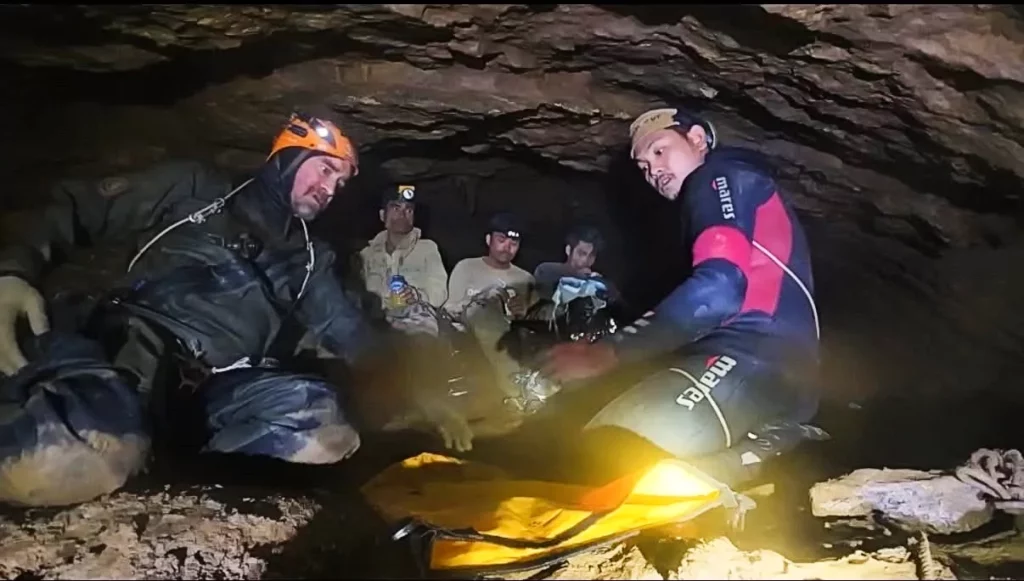
Five Miners Rescued from Flooded Laos Cave After 10 Days; Two Still Missing
Seven artisanal gold miners became trapped in a flooded cave in Xaisomboun Province, Laos, on May 19, 2026, after monsoon rain and a landslide sealed the entrance. An international team of specialist cave divers located five survivors alive and extracted them in two phases — one miner via a perilous guided scuba dive on May 29, and four more on May 30 after pumping operations lowered water levels enough for the group to exit largely under their own power. Two individuals remain missing as of May 31, with over 100 rescuers continuing search operations through flooded, hazardous tunnels. The rescue draws on the same small global network of civilian cave-diving specialists who executed the 2018 Tham Luang extraction in Thailand, exposing a recurring structural hazard across Southeast Asia: informal miners entering karst cave systems in monsoon season with no emergency protocols and no local rescue capacity capable of retrieving them.
The rescue tests and extends the operational limits established by the 2018 Tham Luang cave rescue in Thailand, demonstrating that the small global network of specialist cave divers capable of guided extraction of untrained persons through flooded passages is being deployed repeatedly across Southeast Asia's monsoon-prone karst cave systems — a recurring structural hazard driven by informal mining economies, monsoon intensification, and minimal local rescue infrastructure. The fate of the two missing miners and the question of whether the self-rescue element of this operation reflects an evolution of technique or a forced improvisation carry implications for future cave rescue planning in the region.
The facts, with receipts.
Seven artisanal gold miners entered a cave in Xaisomboun Province, Laos, and became trapped when flash flooding blocked their exit.DW News
Five of the seven trapped miners were rescued alive.CBC News
One miner was rescued on Friday, May 29, 2026.CBC News
Four additional miners were rescued on Saturday, May 30, 2026, after being trapped for 10 days.CBC News
Two miners remain missing as of May 30–31, 2026, with search operations ongoing.CBC News
The full briefing.
Five artisanal gold miners have been brought out alive from a flooded cave in Xaisomboun Province, Laos, after more than ten days trapped underground — but two members of the original group remain missing, and an international team of specialist cave divers is still searching through narrow, hazardous tunnels as of May 31, 2026.
The seven miners entered the cave on May 19, searching for gold in what is a common informal economic activity in this remote highland province. Heavy monsoon rain and a landslide sealed the entrance before they could exit. Rescuers located five of the seven alive on a rock shelf inside the cave approximately eight days after the entrapment, while the other two could not be found. In the days before extraction began, the international dive team conducted multiple provision runs — each round trip taking around four hours — to deliver food and air to the survivors.
Five of the seven trapped miners have been rescued alive; two individuals who may have entered the cave earlier than the main group remain missing as of May 31, 2026, with over 100 rescuers including international dive specialists continuing search operations in difficult flooded conditions.
The first extraction, on Friday, May 29, was the most technically demanding. Lead diver Mikko Paasi — a Finnish specialist who also participated in the 2018 rescue of 12 boys from a flooded cave in Thailand — guided a miner through partially submerged passages in an operation that took two hours. The miner had never used scuba equipment before. Paasi described the technique as a "trust-me dive," with the miner physically held between two divers through the submerged sections, completely dependent on their control. The conditions inside the cave complicated the operation further: near-zero visibility in murky water, sharp rocks, confined passages, the risk of tunnel collapse, and hydrogen sulfide gas contamination that made deploying fresh air equipment difficult.
On Saturday, May 30, the four remaining located miners were able to exit in a markedly different fashion. Pumping operations had reduced water levels inside the cave sufficiently for the group to walk and crawl with diver assistance rather than requiring full guided scuba extraction. One podcast news bulletin described the Saturday outcome as the miners effectively exiting under their own power once water receded — covering roughly 350 metres to the cave entrance while divers were still preparing for another guided dive. The total number rescued stands at five. Whether the role of water-pumping operations or direct diver intervention was the more decisive factor in enabling the overall rescue is described differently across sources and remains a point of framing divergence rather than factual dispute.
The fate of the two missing miners is the most urgent unresolved element of the story. One source indicates these two may have entered the cave earlier than the main group of five, which could mean they are located in a different section of the cave system — a detail that, if accurate, would significantly complicate search operations. This information comes from a single source and has not been confirmed across the coverage. The physical condition and medical status of the five who have been rescued have not been reported in available coverage, despite the significance of their having spent more than ten days underground in a flooded environment.
The international rescue team assembled for this operation is not a standing organization but an informal network of specialist cave divers — including practitioners from Thailand, Japan, Malaysia, Indonesia, France, and Australia — who respond to cave emergencies across national borders. More than 100 rescuers are involved in total, with approximately 15 having previously participated in the 2018 Thai rescue. That operation, in which all 13 trapped individuals were extracted alive after 18 days underground, established the operational template for guided extraction of untrained persons through flooded passages, and created the network of experienced practitioners now working in Laos. A key difference between the two operations is that the 2018 Thai extractions involved sedation for the underwater passages and weeks of preparation, while the Laos 2026 operation proceeded without sedation and under a more compressed timeline — a distinction that may reflect forced improvisation, an evolution of technique, or both.
The structural conditions that produced this emergency are not unique to this site. Xaisomboun Province is one of Laos's most remote and least economically developed regions, where informal artisanal gold mining is a primary income source for highland communities. The province's karst limestone geology creates cave systems that are prone to rapid, catastrophic flooding when monsoon rain overwhelms drainage capacity. The Laotian government's role in authorizing or coordinating the international rescue team's access has not been documented in any available source. The rescue team is continuing its search for the two missing miners, but neither their location within the cave system nor their status is known.
The numbers that matter.
The same facts.
Different stories.
Rescue Heroism / Human Endurance
High reachVivid physical descriptions of cave conditions; Paasi's 'trust-me dive' and 'miracle' characterizations; the two-hour duration of the first extraction; hydrogen sulfide gas complication; 'essentially diving in coffee' visibility conditions.
Why the miners were in the cave and the economic conditions that drove them there; the miners' own agency and physical resilience; the self-rescue element of the Saturday extraction; the Laotian government's role or absence.
Factual Update / Wire Service
Medium reachNumbers rescued (1 Friday, 4 Saturday, 5 total, 2 missing); timeline (10 days trapped); location (Xaisomboun Province); rescue mechanism (pumping, diver assistance).
Operational details of the rescue; conditions faced by rescuers; identities of those involved; context about the cave or flooding cause; government response; economic background.
Unexpected Self-Rescue / Villager Agency
Low reachThe four miners walked and crawled 350 metres to the entrance under their own power while divers were still preparing; pumping operations as the decisive enabling factor rather than diver-guided extraction.
The first miner's extraction by Paasi, which required full guided scuba diving; the ongoing search for two missing persons; the still-present danger inside the cave system.
What the signal looked like.
Heroic International Diver Rescue
A multinational team of experienced cave divers including Thai, Finnish, Australian, and Malaysian specialists successfully extracted miners from a flooded Laos cave via dangerous 'trust-me' guided dives through narrow submerged passages; the first survivor's extraction was a two-hour perilous operation; more followed.
Miracle Amid Extreme Risk
The rescue is miraculous given tight tunnels, poor conditions, and weakened survivors; divers emphasize that dangers were severe and 'a lot can go wrong,' making each successful extraction extraordinary.
The term 'Laos' peaked at search index value 100 on May 29, 2026 — the date of the first miner's rescue — confirming that event as the primary attention catalyst. 'Laos' remained elevated (values 64–96) through May 30 during the four-miner rescue. Story-specific rising queries include 'josh richards cave diver' (Breakout), 'laos cave rescue' (Breakout), 'josh richards' (Breakout), and 'mikko paasi' (+950%), indicating rapidly growing named-individual search interest. The broader 'Diver' search volume is dominated by unrelated watch and gaming queries and does not reliably signal story-specific attention.
No prediction markets related to the Laos cave rescue or its outcome were identified in Polymarket search results. Returned markets (IndyCar race, US state visit, congressional primary, AI leaderboard, ETH price) are unrelated to this story.
The thread, in order.
Xaisomboun area designated a Lao special administrative zone under military control, established primarily to suppress Hmong resistance and exploit timber resources.
Establishes the region's character as a remote frontier governed through security imperatives, with lasting effects on infrastructure and economic conditions relevant to why artisanal mining is a primary activity in the province today.
Xaisomboun formally established as Laos's 18th province, converted from military-administered special zone to civil province.
Nominally opens the region to civil development, though its remote and mountainous character limits economic integration — the underdevelopment that persists is part of the structural context for artisanal mining activity.
Members of the Wild Boars youth football team and their coach become trapped in the Tham Luang Nang Non cave system in Chiang Rai Province, Thailand, after monsoon flooding.
Foundational prior event for the current story: establishes the international cave rescue network, techniques, and personnel — including Mikko Paasi — now deployed in Laos.
All 13 members of the Wild Boars team (12 boys and their coach) extracted successfully through flooded passages in Tham Luang, completed July 10, 2018.
Creates the operational template and the network of experienced practitioners — including Mikko Paasi — who are now responding to Laos 2026. Establishes sedation-assisted guided extraction as the benchmark technique for extracting untrained persons from flooded cave passages.
Phoykham Hungbounyuang appointed governor of Xaisomboun Province.
Most recent leadership change in the province's civil administration; the governing authority during the rescue operation.
Reports of Lao military operations against Hmong communities in Xaisomboun Province, including deaths of three children and multiple arrests, submitted to UN bodies.
Indicates the province's security situation remains contested and state-community relations in the highland areas are fraught — relevant background for understanding the governance environment in which the rescue operated.
Seven artisanal gold miners enter a cave in Xaisomboun Province searching for gold. Heavy monsoon rain and a landslide seal the cave entrance, trapping all seven inside.
Initiating event of the current story.
International rescue divers locate five of the seven miners alive on a rock shelf inside the cave. Two remain unlocated. Team begins provision delivery runs — each round trip approximately four hours.
Establishes that a survivable situation exists and triggers the extraction planning phase; also introduces the complication of hydrogen sulfide gas and equipment deployment difficulties.
Lead diver Mikko Paasi extracts the first miner in a two-hour guided scuba 'trust-me dive' through partially submerged passages — the miner's first-ever scuba experience.
First successful extraction; establishes the no-sedation, high-improvisation technique used in this operation as distinct from the 2018 Thai precedent.
The remaining four located miners exit the cave under their own power with diver assistance after pumping operations lower water levels sufficiently, crawling approximately 350 metres to the entrance.
Completes the rescue of all five located survivors; the self-rescue element of this extraction — enabled by pumping rather than guided scuba diving — introduces a secondary narrative about the role of water management versus direct diver intervention.
The relationships driving it.
Richards is one individual contributor within a larger multinational team; his specific operational role in the Laos extraction is not detailed in sources.
Five of seven miners extracted as of May 30; search for two missing individuals is ongoing. The team extracted the first miner via guided scuba dive; the remaining four exited under assisted self-power after water receded.
The Association is publicly visible alongside the rescue team, handling media documentation and social media updates.
The team operates within Xaisomboun Province under assumed national-level Lao government authorization; the province's remoteness constrains the operation logistically.
Five rescued; two remain missing within the province's cave system. Province is the site of ongoing search operations.
The Association is serving as a public communications channel for the operation occurring within the province.
What no one is covering.
Cause of the flash flooding: No profile explains whether the flooding was caused by seasonal monsoon rain, an unusually intense rainfall event, a landslide-triggered water release, or upstream hydrological conditions. DW News mentions 'flash flooding' as the mechanism but provides no meteorological or hydrological explanation.
What the trapped individuals were doing in the cave and the nature of their activity: The 'villagers vs. miners' discrepancy between CBC and The Guardian is noted but neither source explains the nature of the mining activity, whether entry was authorized, or what equipment the group had with them.
Physical condition and medical status of the five rescued individuals: After 10 days in a flooded cave, health status (hypothermia, dehydration, injuries) would be newsworthy and relevant to urgency of finding the remaining two. No profile addresses this.
Status and precise location of the two still-missing individuals: Whether rescuers know where the two missing persons are, whether they are believed to be alive, and whether they entered the cave at a different time than the five survivors (which would place them in a different section) is not established in any news profile.
Laotian government role: No profile documents whether Lao national authorities or Xaisomboun provincial authorities requested international assistance, authorized the team's access, or are playing any coordinating role in the rescue.
What we don't know.
Intelligence means marking the edges of what's verified. Here's what this story can't yet answer.
The specific cave's name is absent from all available sources — both news and research. This is unusual and may indicate deliberate omission, that the cave is not formally named in public records, or a consistent gap in early-stage coverage.
The two missing miners may have entered the cave at a different time than the five survivors (one source: cnn.com), which would place them in a different section of the cave system and significantly complicate search operations. This detail appears in only one source and may reflect a reporting ambiguity.
Josh Richards's specific operational role in the Laos extraction — whether he was a primary extraction diver, support diver, or logistics specialist — is not established in any available source.
Whether Josh Richards participated in the 2018 Tham Luang rescue is not confirmed in available sources, unlike Mikko Paasi who is explicitly linked.
The Association of Volunteers for Lao People has essentially no documented institutional history beyond this rescue operation. Its founding, governance, mandate, funding, and diaspora vs. domestic status are entirely undocumented.
Mikko Paasi's institutional affiliation, nationality, and organizational home are not established in available sources despite his being the operational center of the rescue narrative.
The phrase 'essentially diving in coffee' attributed to rescue conditions appears in The Guardian's headline but has no named speaker in the available article text. It cannot be attributed to a specific individual.
The physical condition and medical status of the five rescued miners — after 10 days underground in a flooded cave — are not reported in any available source.
The legal and regulatory status of artisanal gold mining in Xaisomboun Province is not established in available sources, making it impossible to assess whether the miners' activity was permitted, tolerated, or technically illegal.
No Laotian government statements, official casualty figures, or administrative documentation of the rescue operation are available. The mechanism by which an international team was authorized to operate inside Laos is not documented.
Five CNN profiles in the 3A source set contained headline-only text with no article body extracted, limiting their evidentiary contribution to framing signals only.
Who's telling you this.
Left of center.
Mean lean −1.2 across the 22 outlets synthesized.
Scores based on editorial-positioning data. Not an endorsement or criticism.
The story, visualized.
Glossary.
- artisanal gold mining
- Small-scale, informal gold prospecting carried out by individuals or small groups, typically without formal permits, industrial equipment, or regulated safety procedures. It is a common livelihood activity in remote highland areas of Laos and neighbouring countries where formal employment is scarce.
- karst
- A type of landscape formed from soluble rocks — primarily limestone — that produces cave systems, sinkholes, and underground drainage networks. Southeast Asia's highland regions are extensively karst, creating cave systems that can flood rapidly during monsoon rain events.
- trust-me dive
- A cave rescue technique in which an untrained, non-diving person is physically held between two experienced divers and guided through a submerged passage, relying entirely on the divers for navigation and air supply. The technique was used in the Laos 2026 rescue for the first extraction on May 29.
- hydrogen sulfide
- A toxic gas that occurs naturally in some cave environments. At elevated concentrations it is dangerous to breathe and can complicate rescue operations by limiting the time rescuers can safely spend inside the cave without specialised breathing equipment.
- monsoon
- A seasonal weather pattern — dominant across South and Southeast Asia — characterized by intense, prolonged rainfall typically arriving between May and October. Monsoon rain can cause cave systems to flood rapidly, sometimes sealing entrances within hours of a rainfall event that begins far from the cave itself.